


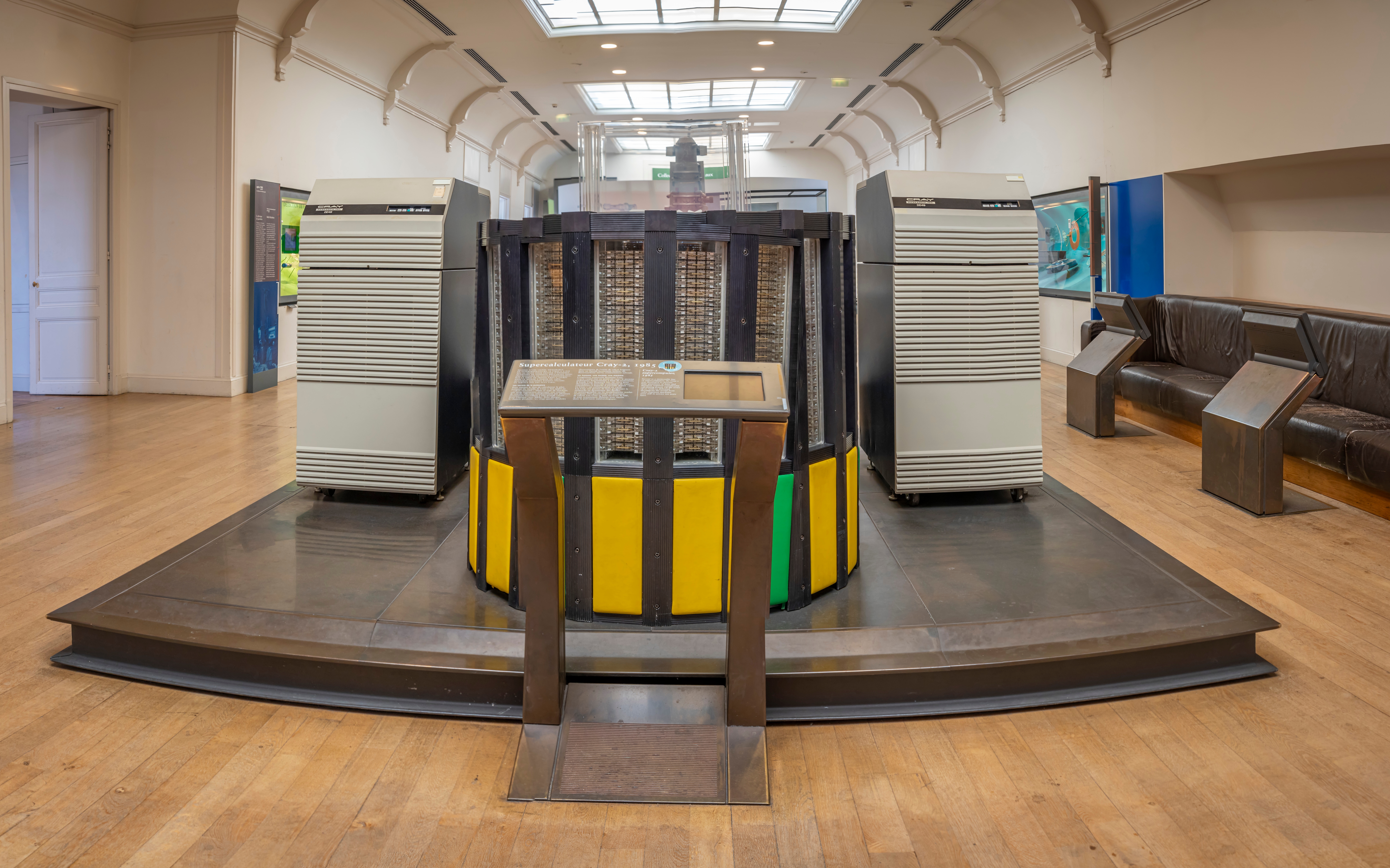
 This week’s Tech Time Warp takes a closer look at “the world’s most expensive loveseat.” It’s quite the moniker for a pioneering supercomputer, but when you look at the legacy of electrical engineer Seymour Cray, it’s apt. The Cray X-MP/48, which started operations 40 years ago this week at the San Diego Supercomputer Center, was one of a series of Cray supercomputers that brought new levels of both style and substance to the industry.
Seymour Cray and the dawn of parallel processing
Let’s start with the substance. Cray’s work, first at Control Data Corporation and then at Cray Research Inc., pioneered the use of parallel processing, or executing two or more instruction streams simultaneously. The X-MP, which became known for generating computer graphics for movies, ran at nearly twice the speed of competing machines. It could run 420 megaflops per second, which each megaflop equating to 1 million floating-point operations. Put two X-MPs together working on different parts of the same problem at the same time, and the operation became even faster. The Cray machines benefited from interleaved memory, which speeds up memory by splitting it into multiple banks and then accessing them in parallel. While one set of data was being accessed, the CPU could simultaneously fetch the next instruction. This removed bottlenecks in processing.
Style meets science
The style, though, of the Cray machines was remarkable. Four vertical towers were grouped together, and surrounding the towers was indeed a circular padded seating space, similar to what one might find at a hip airport lounge or doctor’s office waiting room. The seating covered the Cray’s extensive power supply.
The Cray X-MP/48 was a significant investment, priced at $14.6 million with additional multimillion dollar add-ons needed. But for the government and research sectors that could afford it, the investment was well worth it for the supercomputer’s ability to tackle meteorological modeling, wind turbine design, satellite image analysis, biological imaging, astronomy work, and, yes, digital multimedia.
Did you enjoy this installation of SmarterMSP’s Tech Time Warp? Check out others here.

Photo: Franck Legros / Shutterstock
