

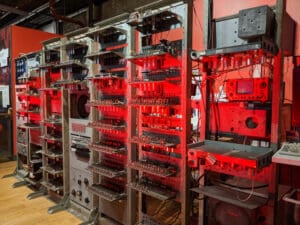
 At 17 feet long and nearly 7 ½ feet tall — and weighing in at almost a ton — it might seem silly today that the “Small-Scale Experimental Machine” built in 1948 at the UK’s University of Manchester was nicknamed “Baby.”
But this “Baby” took the computing world a long way (and actually was much smaller than its contemporary, the ENIAC). On June 21, 1948, the Manchester Baby successfully ran the first stored program, paving the way for modern software.
Prior to the Baby, computers were either single-purpose or had to be physically rewired to complete different tasks. The Baby’s first stored program consisted of 17 instructions programmed to find the highest factor of a given number. By August 1948, Baby could run through 3.5 million calculations in less than an hour, running the stored program with numbers as high as 2 to the power of 18.
Built using surplus war parts, including supplies from Bletchley Park, the Baby was the work of Tom Kilburn and Freddie Williams. The Baby’s Williams-Kilburn tube was the first electronic random-access memory (RAM) device and could store up to 1,024 bits.
The Baby was a proof-of-concept machine, so its place in computer history must be qualified. The concept of a stored program is widely attributed to the 1945 EDVAC design report by John von Neumann. The Cambridge EDSAC is considered the first full-scale stored-program machine. And the first general-purpose commercial computer was the Ferranti Mark 1.
But the Baby deserves its own chapter in technology history. See a working replica at the Science and Industry Museum in Manchester.
Did you enjoy this installation of SmarterMSP’s Tech Time Warp? Check out others here.
Photo: John B Hewitt / Shutterstock